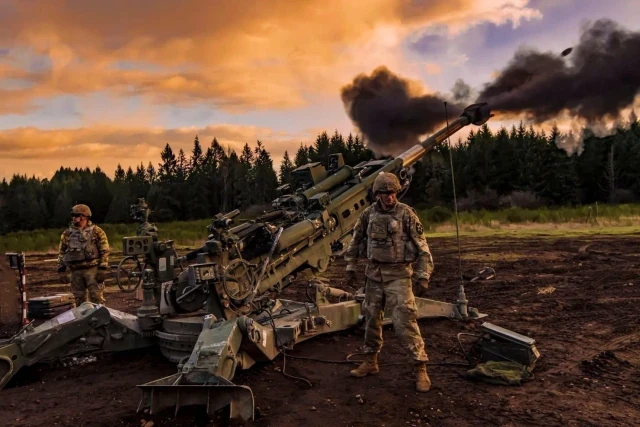
Call for Fire
The whole thing, taught the way you would teach it to a cadet who has never keyed a fire net: the three transmissions and every word in them, the types of mission, which round and fuze for which target, mils and the OT factor, bracketing a round onto a target, and the TTLODAC line that puts a target on the fire support plan. Then a simulator that hands you a randomised target on a 1:50,000 map, lets you talk the mission through with an FDC that reads back, and tells you exactly what you got wrong. Written by a Ranger and Sapper qualified 11B who has called for and adjusted real rounds, for the people who are about to.
Adjust Fire on a Live Map
Two tabs. Learn it first is twelve short interactive lessons, one idea each: drag a burst across a reticle and watch the mils turn into metres, walk the mission-type questions, pick a fuze and see where it functions, bracket a round on an OT line, fill a TTLODAC line and get told why each answer is right or wrong. Run a mission is the simulator: the blue OP is you, the red diamond is the target the brief describes, 1ST PLT is your platoon, the crosses are planned targets already on the guns. Build each transmission, send it, answer the FDC, read the burst against your OT line, bracket him in. Switch Walkthrough on and the grader tells you the right answer and why at every step, and will fill the form for you so you can see what a clean mission looks like before you fly one alone.
Every scenario is generated fresh: new terrain, new grid numbers, new target, new first-round error. The scenario number in the corner is in the page address, so you can send a cadet the exact same problem. Click the map to read a point as a six-digit grid with the direction and distance from your OP; that stands in for your map, protractor and coordinate scale. Zoom tightens the sheet around the engagement; fullscreen gives the map the whole screen.
Don’t Miss the Next Drill
More patrolling and battle drill pages are being built right now, animated the same way. Subscribe and I’ll let you know the moment new tactics, articles, and gear reviews go live.
- The simulator
- The picture: why the guns need you, and why the first round misses
- The call for fire: three transmissions, six elements
- Types of mission: adjust fire, fire for effect, suppress, immediate; grid, polar, shift
- Rounds and fuzes: what to put on what
- The FDC's half: MTO, shot, splash, rounds complete
- Mils, direction and the OT factor
- Spotting, corrections and bracketing
- Fire for effect, surveillance and end of mission
- Smoke and illumination, briefly
- TTLODAC: putting a target on the plan
- Where cadets get it wrong
- Sources
Why the Guns Need You, and Why the First Round Misses
A howitzer battery sits six to ten kilometres behind you and cannot see anything you can see. Between you and it is a fire direction center, the FDC: a few soldiers with a computer who turn what you say into the numbers the gun crews set on the tubes. You are the observer. The whole system is a loop: you describe a target, the FDC computes, the guns fire, you watch where the round lands, you correct, and so on until the rounds are on him. Then the battery fires for effect and you report what happened.
The first thing to get into a cadet's head is that the first round is supposed to miss. The guns are shooting at a point on a map they have never seen, from a position surveyed to a few metres, through air whose temperature, density and wind the FDC can only estimate, with powder lots that vary. The gunnery manual lists dozens of variables. The map spot you gave them is good to perhaps fifty or a hundred metres on a 1:50,000 sheet. Stack all of it and a first round two or three hundred metres off is normal. Adjustment is not a failure; it is the procedure. The skill is turning that unknown error into a known one, fast, with the fewest rounds, without ever putting a round on your own people.
Every spotting you make and every correction you send is along the line from you to the target: the observer-target line, the OT line. Not the line from the guns to the target. The FDC converts. You never think about where the guns are once the mission starts. LEFT and RIGHT are left and right as you look at the target; ADD pushes the burst away from you along that line, DROP pulls it toward you. Draw the OT line on your map before you key the handset and half the mistakes on this page cannot happen.
One more orientation point. In the simulator and on a real fire net the two stations are the observer (you: the forward observer, FO) and the fire direction center (FDC). The guns themselves never talk to you. When the FDC says shot, the round is in the air; when it says splash, it lands in five seconds; when it says rounds complete, the volley you asked for has been fired. Everything else on the net is you.
Three Transmissions, Six Elements
ATP 3-09.30 lists six elements in a call for fire: observer identification, warning order, target location, target description, method of engagement, and method of fire and control. They are sent in three transmissions, with a break after each one so the FDC can read it back. You send the information for each transmission as soon as you have it rather than waiting until the whole thing is worked out, because the FDC starts computing on the first transmission. You end every transmission with OVER. The FDC reads it back word for word and ends with OUT. If the readback is wrong, you say CORRECTION and send the whole element again.
| Transmission | Elements | What it sounds like |
|---|---|---|
| 1 | Observer identification + warning order | FDC, THIS IS OBSERVER 1, ADJUST FIRE, OVER. |
| 2 | Target location | GRID 180513, ALTITUDE 345, OVER. |
| 3 | Target description + method of engagement + method of fire and control | INFANTRY PLATOON IN THE OPEN, VT IN EFFECT, OVER. |
"VT in effect" asks for a variable time fuze, a proximity fuze that bursts the round in the air over the target, for the volley fired for effect. The rounds-and-fuzes section below explains every option; the point here is the shape of the three transmissions.
Transmission 1: who you are and what you want
The observer identification is just call signs: the FDC's, THIS IS, yours. On this page the two stations are simply FDC and OBSERVER 1, and the battery is Bull; on a real net each is a unit call sign, and the shape of every transmission is identical. The warning order clears the net for a fire mission and has three parts: the type of mission (one of ADJUST FIRE, FIRE FOR EFFECT, SUPPRESS with a target number, IMMEDIATE SUPPRESSION or IMMEDIATE SMOKE with a grid), the size of element to fire for effect if you want to ask for one (you usually do not; the FDC decides), and the method of target location. Grid is the standard method and is not announced. If you are sending a polar plot or a shift from a known point, you say so: ADJUST FIRE, POLAR, OVER or ADJUST FIRE, SHIFT AB1001, OVER. Saying "grid" in the warning order is the single most common thing cadets add that the book does not.
Transmission 2: where it is
For a grid mission: the six- or eight-digit grid, then the altitude in metres to the nearest ten if you know it. Six digits locate to 100 metres and is the minimum for a map-spotted target; eight digits locate to ten metres and is what you send for anything that needs to be hit first time. The 100,000-metre square letters go in front of the numbers when there could be any confusion. You do not send direction here on a grid mission; the FDC does not need it to plot the target. Direction comes with the first correction.
Transmission 3: what it is, what to shoot at it, how to control it
The target description is brief and tells the FDC what, what it is doing, how many, and how protected: platoon of infantry in the open, digging in; machine gun bunker with overhead cover; three trucks on the road, troops dismounting. The FDC uses it to pick the shell and fuze you did not specify and to decide how many rounds. The method of engagement is where you ask for anything non-standard: a different projectile or fuze (VT IN EFFECT, DELAY, SMOKE IN EFFECT), DANGER CLOSE if friendlies are within 600 metres of the target, high angle if you need it. If you say nothing, you get high explosive (HE) with fuze quick in adjustment and the fire direction officer's choice in effect. The method of fire and control is how the mission is run: say nothing and the guns fire when ready; AT MY COMMAND holds the round until you say FIRE; TIME ON TARGET 0859 lands the first volley on a clock time; REQUEST SPLASH asks the FDC to warn you five seconds before impact. Mortars and high-angle fire get SPLASH anyway.
Radio words that matter on a fire net: OVER means I am done and I want a reply; OUT means I am done and I want nothing. They are never used together. SAY AGAIN means repeat your last transmission. REPEAT is a fire command (fire the same thing again) and is never used to mean "say again"; it is also never sent in the initial call for fire. Numbers are sent digit by digit: direction 1680 is "one six eight zero", not "sixteen eighty".
Adjust Fire, Fire for Effect, Suppress, Immediate
The type of mission is the first thing after your call sign, and choosing it is a tactical decision, not a format choice. Here is the logic.
| Mission | When | What happens |
|---|---|---|
| ADJUST FIRE | Target location is doubtful (a map spot, no laser, no registration) or you are not sure the first volley would do the job. The default for a cadet. | One gun fires one round; you correct it onto the target; then the battery fires for effect. |
| FIRE FOR EFFECT | You are certain the location is accurate (eight-digit grid from a laser or a mensurated point, or a planned target) and the first volley will have the effect you want. The book says to strive for first-round fire for effect, and it says to use it only when you are sure. | The whole battery fires straight away. No adjusting round, no warning to the enemy. |
| SUPPRESS AB1001 | A planned target that is not active yet needs to be kept down for a period, usually while you move. | The guns fire on the planned target for a stated duration. Normally used with targets already on the fire support plan. |
| IMMEDIATE SUPPRESSION | The target has taken friendly troops under fire right now. Speed over precision. | One transmission with the grid in it: FDC, THIS IS OBSERVER 1, IMMEDIATE SUPPRESSION, GRID 211432, OVER. A two-gun section fires two rounds each, HE or VT, immediately. No adjustment. |
| IMMEDIATE SMOKE | Friendlies are under fire and you need the enemy's eyes off them now. | Same one-transmission format with a grid. White phosphorus (WP) first for a fast build, then smoke. Effective about thirty seconds after impact, lasts four or five minutes. |
Planned targets versus targets of opportunity
Most of what a platoon shoots in a fight is a target of opportunity: something you see, locate and call in on the spot. A planned target is one that was put on the fire support plan before the operation, with a target number, a grid and a trigger, and the FDC already has the data on the guns. Planned targets are either scheduled (fired at a set time) or on-call (fired when the trigger happens). A priority target is a planned target the guns lay on whenever they are not firing something else, so the response is seconds; each firing unit has one. In the defence, the final protective fire, the FPF, is a priority target fired at the maximum rate until told to stop, and it is called with FIRE THE FPF. A target reference point (TRP) is just an easily recognised point on the ground used to control fires; it only becomes a target when it is given a target number.
The practical payoff: before you build a grid mission, look at your target list. If the enemy is sitting on or near a planned target, call the number. FIRE FOR EFFECT, TARGET AB1001 or SUPPRESS AB1001 puts the battery's rounds on him with no adjustment, because the work was done the night before. The simulator puts planned targets on the sheet for exactly this reason.
Three ways to say where it is
| Method | Transmission 2 | Notes |
|---|---|---|
| Grid (not announced) | GRID 180513, ALTITUDE 345, OVER. | The standard. Six digits minimum for a map spot; eight for anything you want hit first time. Direction is not part of it; it comes with the first correction. |
| Polar (announce POLAR) | DIRECTION 4520, DISTANCE 2300, DOWN 35, OVER. | The FDC plots the target from your position, so the FDC must already know your location. Direction to the nearest 10 mils, distance to the nearest 100 m (10 m with a laser), vertical shift only if the target is 35 m or more above or below you. Fast when you have a compass and a laser rangefinder; your direction and distance errors go straight into the first round. |
| Shift from a known point (announce SHIFT and the point) | DIRECTION 5210, LEFT 380, ADD 400, DOWN 35, OVER. | The least preferred and hardest method. You send the OT direction to the target, then the lateral and range shifts measured along that line from the known point, then the vertical shift. Lateral shift comes from the mil relation. If the shift is more than 600 mils, use another method. |
Preference order in the book: mensurated grid, laser grid, laser polar, map-spot grid, polar plot, shift from a known point. A cadet with a map and a compass lives at map-spot grid, which is why the default mission is adjust fire.
Rounds and Fuzes: What to Put on What
The shell is what arrives; the fuze is when it functions. High explosive, HE, is the shell for almost everything, and the fuze is the choice that decides whether it does anything. You adjust with HE and fuze quick by default; what you ask for in effect is the decision.
| Round / fuze | What it does | Use it on | Do not use it on |
|---|---|---|---|
| HE, QUICK (point detonating) | Functions on impact. Fragments spray out and up from the ground. The default in adjustment; you do not have to ask for it. | Troops and soft vehicles in the open; observation posts and anti-tank guided missile (ATGM) teams where speed matters more than the fuze; clearing camouflage and earth off a bunker before delay rounds go in. | Troops below ground level (the parapet eats the fragments). Overhead cover, on its own. |
| HE, DELAY | Functions a fraction of a second after impact, after it has penetrated. | Bunkers and fighting positions with overhead cover, dugouts, caves, buildings. The gunnery manual pairs overhead cover with quick/delay and says 155 mm or bigger for dugouts. | Troops in the open. The round buries itself and most of the fragmentation goes into the dirt. |
| HE, VT (variable time: a proximity fuze) | Senses the ground and bursts about 7 m above it. No height-of-burst adjustment needed. Fragments come down into holes. | Troops in the open or in positions without overhead cover: the gunnery manual's preferred fuze for killing and for suppressing them. Trenches. Mortar crews at their tubes. Armour, to force it to button up and move. | Overhead cover: an airburst over a log roof does nothing to the crew underneath. |
| HE, TIME | Bursts at a set time of flight; the observer adjusts the height of burst to about 20 m. More work than VT, same effect, and it does not care about terrain or trees. | Same targets as VT. You request FUZE TIME once range and deviation are correct, adjust the height of burst, then fire for effect. | Overhead cover. Never say TIME with illumination, improved conventional munitions (ICM, the cluster round) or smoke; those are time-fuzed already. |
| SMOKE (M825) | Builds a screen in about half a minute, lasts five to ten minutes. Does not kill. | Screening your own movement (between the enemy and you) or obscuring an enemy observer or gun (on him). Immediate smoke when under fire; quick smoke when there is time to adjust. | Anything you want dead. Smoke to "engage" infantry is the classic wrong answer. |
| WP | White phosphorus (WP). Fast, bright, short-lived smoke; burns; marks. | Marking a target for aircraft or other observers; the first round of immediate smoke; burning soft vehicles and ammunition. | Anywhere near friendlies without thinking about the cloud. It is not the killing round. |
| ILLUMINATION | A flare under a parachute, 600 m up for 155 mm, burning two minutes. | Seeing at night. Adjust the flare over the target, then run HE under it with coordinated illumination. | Anything you want to hit. It has no effect on the target and it lights your own people up too. |
If the target, or where the rounds will land, is within 600 metres of any friendly troops for mortars and cannon artillery (750 m for 5-inch naval guns), you announce DANGER CLOSE in the method of engagement, and you change how you adjust: no bracketing, creeping fire only, corrections of 100 metres or less, walking the rounds onto the target so a short round never lands on your own people. If adjustment brings the rounds inside 600 metres part-way through a mission you announce DANGER CLOSE then; when they are outside it again, CANCEL DANGER CLOSE.
Two more things live in the method of engagement. Trajectory: low angle is standard; ask for HIGH ANGLE to get over a ridge or into a deep valley, and remember mortars only fire high angle. Sheaf: how the battery's rounds are spread. The default is a circular pattern 100 m across; CONVERGED puts every round on one point for a small hard target; LINEAR with a length and attitude lays them along a trench line. You will rarely need to say any of it as a platoon leader, but you should know the FDC is deciding it from your description.
Message to Observer, Shot, Splash, Rounds Complete
Once the FDC has your third transmission it sends the message to observer, announced with those words. Every mission gets a target number here, planned or not: two letters and four digits, AB1000 on this page. It is how the FDC files the data and how you refer to the mission if more than one is on the net. Four things, always in this order: the unit that will fire (the battery's call sign: BULL here), any changes to what you asked for (VT IN EFFECT if the fire direction officer overrode you), the number of rounds per gun in effect, and the target number. Write the target number down. Every later transmission on a busy net is tied to it, and the first thing a cadet forgets under stress is which number was his.
Then the FDC's three commands, each acknowledged with OUT:
- SHOT, OVER. A round has left the tube. Sent after every adjusting round and after the first volley in effect. Start watching the target. SHOT, OUT.
- SPLASH, OVER. Five seconds to impact. Sent if you requested it, and always for high-angle fire and mortars. SPLASH, OUT.
- ROUNDS COMPLETE, OVER. The rounds you asked for in effect have all been fired. Now you observe and report. ROUNDS COMPLETE, OUT.
Two FDC messages you should recognise. READY means the guns are laid and loaded after you said AT MY COMMAND; you answer READY, OUT and then FIRE when you want it. PROBABLE ERROR IN RANGE GREATER THAN 38 METERS tells you the guns are shooting at a range where their natural scatter is big; it changes when you can go to fire for effect (below). If the FDC reads back the wrong grid, the whole mission goes to the wrong grid square. Listen to every readback digit by digit and answer a wrong one with CORRECTION or NEGATIVE and the right data.
Mils, Direction and the OT Factor
Artillery measures angles in mils: a circle cut into 6,400 slices. The reason the system exists is this: one mil is one metre wide at one thousand metres. Twice as far, twice as wide: two metres at 2,000 m, three at 3,000. That one fact turns an angle you read on your binoculars (the scale across the middle is marked every 10 mils) into a distance on the ground with no trigonometry. Mils times the distance in thousands of metres equals metres. A burst 40 mils left of a target 3,000 m away is 40 × 3 = 120 m left of it. It works backwards too: a field you know is 200 m wide that fills 10 mils of the scale is 200 × 1,000 / 10 = 20,000, so 2,000 m away. The second lesson in the simulator's Learn tab animates both.
Direction
Direction is the grid azimuth from you to the target, in mils, to the nearest ten. You get it with a protractor on the map or a compass converted from magnetic to grid; degrees times 17.8 gives mils. The FDC needs it to turn your LEFT, RIGHT, ADD and DROP into gun data, which is why it goes with the first correction (or on the end of the MTO readback). You send it again only if it changes by more than 100 mils, which happens when a target moves a long way or you shift to a new one.
The OT factor
OT is observer-to-target. The OT distance is how far the target is from you, measured on the map or with a laser. The OT factor is that distance in whole thousands of metres, rounded so you can multiply by it in your head under stress, and it is the multiplier for every deviation correction in the mission. The rounding:
- Over 1,000 m: round to the nearest thousand and drop the zeros. 2,300 m is 2. 3,400 m is 3. 1,700 m is 2.
- Exactly halfway (1,500, 2,500, 3,500): round to the nearest even number. 1,500 is 2. 2,500 is 2. 3,500 is 4.
- Under 1,000 m: round to the nearest hundred and express it in tenths. 760 m is 0.8. 400 m is 0.4.
Then a deviation spotting in mils times the OT factor is the correction in metres, rounded to the nearest ten. 30 mils right at OT factor 2 is 60 metres: you send LEFT 60, because the correction is the opposite of the spotting (the burst is right of the target, so you move the burst left). A correction under 30 metres is minor and is not sent except as refinement at the end; it is inside the guns' own scatter.
| OT distance | OT factor | Spotting | Correction |
|---|---|---|---|
| 4,000 m | 4 | 45 mils right | LEFT 180 |
| 2,500 m | 2 | 100 mils left | RIGHT 200 |
| 3,400 m | 3 | 55 mils left | RIGHT 160 (165 rounds to 160) |
| 1,500 m | 2 | 20 mils right | LEFT 40 |
| 700 m | 0.7 | 45 mils left | RIGHT 30 |
| 2,000 m | 2 | 10 mils right | (20 m: minor, not sent) |
Work the OT factor and the direction out before the first round lands, while the FDC is computing. Once SPLASH comes you should be doing arithmetic, not measuring. The standard on the lane is a correction within 45 seconds of the burst.
Spotting, Corrections and Bracketing
When the round lands you make three spottings, in this order, always along the OT line: height of burst (air or graze; only matters with a time fuze), range (over or short of the target), deviation (left or right, in mils off your reticle, to the nearest 5 mils for area fire). The trick for range, taught at every school: put the horizontal line of your reticle on the base of the target before the round lands. A burst that appears above the line is over; below it is short. Mark it in your head before the dust spreads.
Corrections go back in the reverse order: deviation, then range, then height of burst. A full correction is DIRECTION 1680, LEFT 60, DROP 400, OVER; after the first one you leave direction off unless it changes. If you need to change anything else, it goes in a fixed sequence before the deviation: direction, danger close, trajectory, method of fire, sheaf, projectile, fuze, volume, then deviation, range, height of burst, then any change to the mission type or control, then SPLASH or REPEAT. You will almost never send more than three of those.
Successive bracketing: the method you learn first
The idea is to get one round over and one round short, which proves the target is between them, then halve the distance until the bracket is 100 metres, then split that and fire for effect. The book says it mathematically ensures the rounds in effect land within 50 metres of the adjusting point, which is why it is the technique for an inexperienced observer and for anything that has to be precise.
- First range correction: big enough to cross the target. Use the ladder: 100, 200, 400 or 800 metres, so the halving stays easy. The mortar manual's starting guide by OT distance: under 1,000 m start with 100; 1,000 to 1,999 m start with 200; 2,000 m and beyond start with 400. If the round was obviously a long way off, go bigger. A correction that lands on the same side as the last round has taught you nothing: that is "chasing", and it costs rounds.
- Fix deviation at the same time. Mils times OT factor, nearest ten metres, opposite the spotting. After the first correction the rounds should be on line; you do not bracket deviation.
- Once bracketed, split. Round over, round short: send half the bracket toward the middle. 400 becomes 200, 200 becomes 100.
- At the 100 m bracket, split it and fire for effect. ADD 50, FIRE FOR EFFECT, OVER. That 50 is the last adjustment; it goes out with the volley.
Two short-cuts. If a round lands within 50 metres of the target at any point, you can fire for effect from it, with a refinement if you want one. And if the FDC told you the probable error in range is 38 metres or more, you may fire for effect from the 200 m split; the guns cannot do better than that anyway.
The other three techniques
- Hasty bracketing. For an experienced observer. Establish one bracket, use it as a yardstick to judge the distance, then send the correction straight to the target with FIRE FOR EFFECT. Faster, fewer rounds, and it depends entirely on how good your eye is. The book's example: first round short and 35 mils right at OT factor 4, so LEFT 140, ADD 200; second round over and 10 left, so RIGHT 40, DROP 50, FIRE FOR EFFECT.
- One-round adjustment. A laser rangefinder on the burst and on the target gives you the exact shift. One correction, then fire for effect.
- Creeping fire. Mandatory for danger close. No bracketing; corrections of 100 metres or less, walking the rounds toward the target from the safe side. The Ranger Handbook is blunt about it: avoid the bracketing method, use only creeping, no correction over 100 metres.
The Expert Infantryman Badge task "Adjust Indirect Fire" (USAIS Pamphlet 350-6) is the cleanest statement of what a GO looks like, and the simulator's debrief scores you against it line by line: the call for fire transmitted in proper sequence within 3 minutes of identifying the target; the target located within 250 metres; direction within 100 mils, to the nearest 10, with the first correction; each round spotted as over, short, left or right and the correction sent within 45 seconds of impact, ignoring deviations under 30 metres; successive bracketing until the 100 metre bracket is split or a round is range-correct; fire for effect using no more than six rounds (the first plus five adjusting); then refinement if needed, end of mission and surveillance. A first round that lands on the target skips straight to fire for effect: no correction, so no direction or OT factor is owed.
REPEAT in adjustment means fire another round with exactly the same data, no corrections. REPEAT in effect means fire the same number of rounds the same way, and you can attach a correction to it: RIGHT 30, ADD 50, REPEAT, OVER. It is never a request to say something again, and it is never sent in the initial call for fire.
Fire for Effect, Surveillance and End of Mission
Fire for effect is the mission. Everything before it was setting up the shot. (In the scripts below, RPG is a rocket-propelled grenade team and a BMP is a Russian-pattern infantry fighting vehicle.) When ROUNDS COMPLETE comes, you watch the target and you owe the FDC two things: refinement, if the rounds were slightly off the target, and surveillance, what the fire did. Then END OF MISSION. If the effect was not enough, you do not end the mission; you repeat, with or without a correction, while the data is still on the guns.
| Rounds were | Effect was | You send |
|---|---|---|
| Accurate | Sufficient | END OF MISSION, RPG TEAM DESTROYED, OVER. |
| Accurate | Sufficient, keep it on the guns | RECORD AS TARGET, END OF MISSION, BMP NEUTRALIZED, OVER. |
| Slightly off | Sufficient | RIGHT 20, ADD 20, END OF MISSION, RPG TEAM DESTROYED, OVER. |
| Slightly off | Not sufficient | RIGHT 30, ADD 50, REPEAT, OVER. |
| Accurate | Not sufficient | REPEAT, OVER. |
| Well off | Nothing | RIGHT 30, ADD 100, ADJUST FIRE, OVER. (back into adjustment) |
The surveillance words have definitions, and the company commander makes decisions on them. Destroyed means the target is out of action permanently or for a long time: at least 30 percent casualties or materiel damage. Neutralized means ineffective for a short period: at least 10 percent. Suppressed means he kept his head down while the rounds were landing and will be back as soon as they stop. Report what you saw: END OF MISSION, 15 CASUALTIES, PLATOON DISPERSED, OVER; END OF MISSION, TWO TANKS DESTROYED, THREE IN WOODLINE, OVER. Calling a suppressed platoon "destroyed" tells the commander a threat is gone when it is not; that gets people killed later in the day.
RECORD AS TARGET asks the FDC to keep the final data as a planned target with its number, so the next time something appears there you call the number and skip the adjustment.
Smoke and Illumination, Briefly
Smoke comes in two missions. Immediate smoke is the one-transmission version for troops under fire: IMMEDIATE SMOKE, GRID 628543, OVER; the FDC fires WP first for a fast build, then smoke, on the target itself. Quick smoke is the deliberate one: you call ADJUST FIRE, adjust with HE until the 200 m bracket is split, request SMOKE for a check round, then fire for effect with smoke. The third transmission carries the screen data: what you are screening, LENGTH in metres, the maneuver-target line (MTL) as a direction, the wind relative to it (LEFT CROSS, RIGHT CROSS, HEAD, TAIL) and the DURATION you need. SCREEN TREE LINE, LENGTH 200, MTL 1800, LEFT CROSS, DURATION 8 MINUTES, SMOKE IN EFFECT, OVER. A 155 mm M825 round builds in half a minute and covers about 350 m across the wind for five to ten minutes; the FDC works out how many rounds and how often from your length and duration.
Illumination is requested as the projectile: VEHICLE NOISES, SUSPECTED TANKS, ILLUMINATION, OVER. You adjust the flare over the target in corrections of 200 m or more and the height of burst in 50 m steps: a flare that burns out in the air comes DOWN, one that burns on the ground goes UP. When the light is right you send ILLUMINATION MARK, then COORDINATED ILLUMINATION, and the FDC times the HE to land while the flare is at its best; from then on each correction is prefixed with which round it is for (ILLUMINATION, ADD 200; HE, RIGHT 60, DROP 100). Two guns, a range spread or a lateral spread light a bigger area; continuous illumination eats ammunition and is the last choice. Infrared (IR) illumination exists and is requested by name.
A MARK mission (MARK KNOWN POINT 1, usually with WP or a high airburst) is how an observer who has lost orientation gets a known burst to shift from. It is also how you point an aircraft or another observer at a target.
TTLODAC: Putting a Target on the Plan
Everything above is executing a target. TTLODAC is planning one: the Ranger Handbook's checklist for a leader building the fire support part of an order, so that every target on the plan is complete before it goes to the FDC and before the OPORD. One line per target. If you cannot fill a column, you do not have a target yet; you have a wish.
What it looks like filled in
| Target | Trigger | Location | Observer | Delivery | Attack guidance | Comms |
|---|---|---|---|---|---|---|
| AB1001 enemy squad observation post on the hilltop (ambush: it covers his reinforcement route) | Lead enemy vehicle crosses the creek ford at target reference point 2 | Grid NK 180 513, altitude 345 | Primary: platoon leader. Alternate: 1st squad leader | Battalion 120 mm mortars | HE, VT fuze, 2 rounds, neutralize, 2 minutes; then shift to AB1002 on order | Battalion mortar fire net; alternate: company command net |
| AB1002 enemy platoon in the trench line on the objective (raid: isolate it for the support by fire) | Assault element at phase line BLUE, breach lane open | Grid NK 184 520, length 200, attitude 2600 | Primary: forward observer. Alternate: weapons squad leader | Direct-support 155 mm battery | HE, VT fuze, 3 rounds, suppress until the assault reaches ALPHA; smoke on order to cover the withdrawal | Artillery fire net; alternate: company command net |
| AB1003 final protective fire (defence) | On order from the company commander when the enemy breaches the wire at phase line RED | Grid NK 170 505, attitude 1900, length 200 | Primary: platoon leader. Alternate: platoon sergeant | Company 60 mm mortars, 2 tubes | HE, delay in adjustment, DANGER CLOSE, maximum rate until CEASE LOADING | Company fire net; alternate: green star cluster |
Two mechanics underneath the matrix. Target numbers are two letters and four digits (AB1234); the first letter comes from the senior headquarters, the second from your echelon, and each unit gets a block of numbers, so a platoon leader uses the numbers he was given and nobody else's. Triggers for moving targets are built backwards from the guns: reaction time plus time of flight, times the enemy's speed, is how far from the target he has to be when you key the handset. The book's planning figures are 30 to 60 seconds for a priority target, 90 to 120 for an on-call target and two and a half to three minutes for a target of opportunity, each plus time of flight. The rehearsal that matters is the primary observer reading his TTLODAC line out loud over the radio, then saying the call for fire, then the alternate doing the same.
The Ranger Handbook also offers PLOT-CR (purpose, location, observer, trigger, communication, resources) as a way to brief the same information in the OPORD. Same questions, different order. TTLODAC is the order the fire support people like to see it in.
Where Cadets Get It Wrong
Correcting from the gun-target line
Every spotting and every correction is along the line from you to the target. If the guns are off to your left, ADD still means away from you, not away from the guns. The FDC converts; you never do.
No direction with the first correction
On a grid mission the FDC cannot turn LEFT 60, DROP 400 into gun data until it knows your OT direction. Send it with the first correction or on the end of the MTO readback.
Mils sent as metres
A 40 mil spotting at 3,000 m is 120 m, not 40. Work the OT factor out before the first round lands and multiply every time.
Chasing instead of crossing
A 100 m correction on a round that was 300 m short lands another round short and teaches you nothing. Make the first range correction big enough to put the next round on the other side.
Bracketing deviation
Deviation is a measurement, not a guess: mils times OT factor, nearest ten metres, done. Only range is bracketed.
Breaking the ladder
ADD 100 at the 100 m bracket, or ADD 50 without FIRE FOR EFFECT, or "drop 300". Use 100, 200, 400, 800, halve, and at 50 go to effect.
Bracketing danger close
Inside 600 m you creep: 100 m or less per correction, from the safe side. And you said DANGER CLOSE in the third transmission so the FDC knows.
Fire for effect from a map spot
A six-digit grid read off a 1:50,000 sheet is an ADJUST FIRE grid. FIRE FOR EFFECT is for a laser, a planned target or a registration.
Wrong fuze for the cover
VT over a bunker roof does nothing. Delay against troops in the open throws the burst into the dirt. Read the protection in your own target description and pick the fuze from it.
Smoke to kill, HE to screen
The task decides the round. A crossing under observation needs smoke between him and you; a mortar section needs HE airburst. Never confuse the two.
Not listening to the readback
The FDC reads back so you can catch the wrong digit. The 82nd's lane video has a candidate let "2815" stand for "2810". On a grid that is a wrong grid square.
"Repeat" for "say again"
REPEAT fires the guns. SAY AGAIN gets you the message again. Three separate instructors on YouTube call this out and every one of them has heard it on a live net.
Ending without surveillance
END OF MISSION on its own is incomplete. Refinement if needed, RECORD AS TARGET if wanted, then what the fire did and how many casualties you can count.
Numbers said as words
"Sixteen eighty" is not a direction. One six eight zero. Thirty becomes three zero. Every digit, every time.
Sources
- ATP 3-09.30, Observed Fires (2017) — the call for fire (chapter 4: the six elements, the three transmissions, the MTO, danger close at 600 m, methods of control), adjustment (chapter 5: spotting, the OT factor and its rounding rules in table 5-1, corrections in reverse order, successive and hasty bracketing, creeping fire, the fire-for-effect decision and the 38 m probable-error rule, refinement and surveillance in table 5-2) and the special missions (chapter 6: smoke, illumination, ICM).
- TC 3-09.81, Field Artillery Manual Cannon Gunnery (2016) — shell and fuze characteristics and the guide for attack of typical targets (table 3-2): proximity or time for personnel without overhead cover, quick or delay for overhead cover, delay for dugouts, airburst to button up armour.
- TC 3-21.76, Ranger Handbook (2017) — the fire support chapter: the TTLODAC checklist (table 3-5), the call for fire and adjustment examples (table 3-6), danger close and creeping fire, risk estimate distances, and PLOT-CR in the OPORD format.
- TC 3-22.90, Mortars (2017) — mortar rounds and ranges, and the initial bracket guide by OT distance (table 7-1).
- FM 3-09, Fire Support and Field Artillery Operations (2020) — the definitions of destroy (30 percent), neutralize (10 percent) and suppress.
- ATP 3-09.42, Fire Support for the Brigade Combat Team (2016) — trigger development and the radio rehearsal in which observers brief target, trigger, location, observer, delivery, attack guidance and net.
- Training videos checked against the above: 3rd BCT, 82nd Airborne, P1: Adjust Indirect Fire (the lane standards: locate within 250 m, direction within 100 mils, two to six corrections, 45 seconds each); RangerKSchool, Fire Support Range Corrections – Bracketing; U.S. Army ROTC Curriculum, MSL 302L29 Call for Fire (a 13F, an Army fire support specialist, coaching a cadet through a live 81 mm polar mission); Raider Brigade fires cell, 6 Elements of Call for Fire; Gordon Cooke, West Point Simulation Center, Lesson 27 (TTLODAC as graded); Cyclone Battalion and the Unofficial Army Cadet Guide ROTC walkthroughs; Bravo Three, a live 81 mm mission at the Marine Corps' Basic School.
The simulator fires a battery of six M777 155 mm howitzers with a representative round-to-round scatter and a hidden first-round error that stands in for met, survey and target-location error. Distances, casualty figures and effects are a model, tuned so that correct procedure produces the result the manuals describe. Where the manuals disagree (the naval danger-close distances), the page follows ATP 3-09.30. The phrase "fire for effect, target AB1001" for an on-call planned target is the doctrinally consistent form; ATP 3-09.30 shows "suppress AB1001" and "fire the FPF" verbatim and gives no example for firing an ordinary planned target for destruction.
More Like This
 // tactics
How to Pack a Ruck: MOLLE II Layer by Layer
The MOLLE II Large Rucksack packed layer by layer in an interactive cutaway: what goes where and why, waterproofing, fit, and the load standards.
Read it → // tactics
Conduct a Platoon Raid, Animated Step by Step
Thirty-two phases: the recon, the AT4 and the guns, the breach, building by building, and the phased withdrawal.
Read it → // tactics
Occupy a Patrol Base, Animated Step by Step
From the combat football to the R&S teams, in 23 animated phases.
Read it →The 4-Week Hybrid Military Program
The exact framework I use myself — built for the soldier juggling unit life, school, and a real schedule. Free PDF delivered to your inbox in under 60 seconds.
- 5 lift days · 3 run days per week, supersets for 45-minute sessions
- Week-over-week progressions targeting AFT and combat-MOS standards
- Hybrid framework — strength, conditioning, and recovery, balanced
- Built around real soldier schedules — unit time, school, family
@warfighterforged
Daily carousels. Real soldier breakdowns.