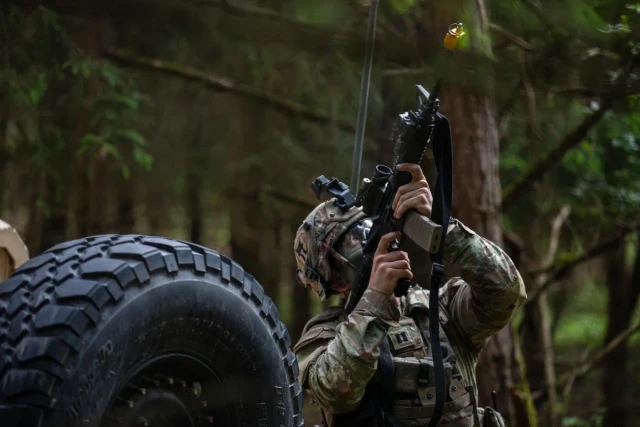
React to a Drone
The newest Army battle drill, and the one the war in Ukraine is written in. Contact report, freeze, the PL’s call to shoot or stay quiet, the football-field lead, smoke, and getting off the grid before the rounds land — the platoon reaction to an enemy UAS, animated step by step by a Ranger and Sapper qualified 11B.
React to UAS, Phase by Phase
Fifteen phases across two views — the approach where the drone finds the platoon, then the new position after it breaks contact. The red aircraft is the enemy UAS; watch where it goes. Tap the map for fullscreen; use the arrows to step through at your own pace.
As an Amazon Associate, WarfighterForged earns from qualifying purchases · Affiliate disclosure
Don’t Miss the Next Drill
More patrolling and battle drill pages are being built right now, animated the same way. Subscribe and I’ll let you know the moment new tactics, articles, and gear reviews go live.
Task · Conditions · Standards
React to an unknown or adversary unmanned aircraft system (UAS) while dismounted, as a platoon.
The platoon is conducting operations dismounted as part of a company or larger force, moving or stationary, and detects an unknown or adversary UAS. The company order has given the platoon the UAS threat, the air defense status, threat tactics, weapons posture, and engagement criteria. Some iterations are performed in MOPP 4 and at night.
The platoon gives the vocal or visual alert, freezes, observes, and assesses the threat. The PL receives the contact report, identifies the UAS as friendly or enemy, determines whether it is engaging, hovering, or crossing, and acts accordingly. The squad leader sends an updated SPOTREP. The PL directs protective actions, reports the platoon’s status, and continues operations according to the order and the commander’s guidance.
What Enemy Drones Do
In April 2025 the Maneuver Center of Excellence approved a new platoon battle drill: 07-PLT-D8015, React to Unmanned Aircraft System While Dismounted. It sits next to React to Contact and React to Indirect Fire in the drill list, and it is there because a seven-dollar quadcopter is now the most common way an infantry platoon gets found and the first link in the chain that gets it killed. The Army built the drill around ATP 3-21.8 and ATP 3-01.81, and its own coaching point is blunt: enemy drones are very difficult to defeat with direct fire, so practice this until the platoon has it cold.
The drill breaks the threat into what a small UAS is actually doing over you. It is a reconnaissance platform — a camera, increasingly a thermal camera, feeding an operator who is looking for exactly what you look like. It is an observer for indirect fire, which is the role that kills the most people: the drone finds you, the guns do the rest, and in Ukraine the time from a drone spotting a target to rounds landing on it has been cut to one to three minutes. It is a strike platform — a first-person-view drone that flies into you at seventy kilometers an hour, or a quadcopter that drops a grenade. And it is an electronic warfare platform that can locate the platoon by the radios and phones it is carrying.
A small drone is hardest to see during the day at a hundred to three hundred meters up; you will almost always hear it first. The quadcopters and FPV drones Ukrainian instructors train against are audible from about a hundred and fifty meters. At FPV speed, that is roughly ten seconds to react. A drone that stops and hovers over you has already found you. Most small UAS have twenty to thirty minutes of battery, which is why breaking line of sight and moving is a real defense and not just a hope.
The jammer-proof drone. Since early 2025 both sides in Ukraine have flown FPV drones that trail a hair-thin fiber-optic cable off a spool instead of using a radio link — up to twenty kilometers of it. There is no signal to jam, so a Dronebuster does nothing to them, and they fly into trenches, bunkers, and buildings where a radio drone loses its link. The Center for Army Lessons Learned put out a Soldier-level primer on them in August 2025 and was blunt that current counter-UAS gear can barely touch them. What they give away: they are heavier and louder than a radio FPV, the cable glints in daylight and stands out in infrared, and a drone that circles an object tends to snap its own line. Ukrainians being chased by one try to get it wrapped around a tree.
The kill zone. The Irregular Warfare Center’s May 2026 field study puts the small-drone kill zone at ten miles and more behind the line of contact; one Ukrainian brigade commander said it ran twenty to twenty-five kilometers in his sector and that his infantry walked twenty-five kilometers to their positions, choosing the weather and the hour, taking three days to a week to get there. Ukraine’s military claimed 96 percent of the Russian casualties it inflicted in March 2026 came from tactical drones. Inside that zone, units move on foot, in small groups, at night, and with escorts: “guides” who pathfind and “stalkers” whose whole job is to hunt drones off the column with shotguns and machine guns. That is where the air guard in this drill comes from. The other thing the study says is worth hearing before the animation: artillery can be acclimatized to, a drone attack cannot. It is single combat against the operator, and it feels like being hunted, because you are.
The JMRC opposing force at Hohenfels runs a dedicated drone platoon against every rotation, trained by Ukrainian brigades straight off the front. In one rotation it executed thirty-four fire missions on units it found from the air, most of them on troops or vehicles in the open. A battalion command post set up outside the treeline took a drone strike, started treating casualties in the open, and the same operator called fire on the aid point and produced a mass casualty. A platoon that popped smoke the moment it spotted the drone and moved broke contact clean. That is the whole spread of outcomes, and the drill is what separates them.
Don’t Be Seen
The drill starts at detection, but the fight starts earlier. The battle drill’s own note on passive protection is two lines: camouflage and signature discipline, including overhead concealment and infrared-blocking material like thermal or emergency blankets with the non-reflective side facing the threat; and short transmissions with brevity codes, because the electromagnetic spectrum is a sensor too. The JMRC drone teams put it more simply: if you can be seen, you can be killed, and cover and concealment is the core counter-UAS principle.
Thermal Is the Problem
Drones are more lethal at night. As the ground cools, a man, a vehicle exhaust, and a generator all glow.
- Thermal blankets and thermal-masking camouflage nets over anyone and anything the canopy does not cover, dull side out.
- Faces, eye protection, and optics shine. That is why the drill says do not look up.
- Fresh dirt from a fighting position is a beacon from above. Cover it with brush.
Shape and Shadow
The human eye — and the operator’s — sees movement first, then shape, then color.
- Crouch in the open to shrink your outline and your shadow. Prone is a bigger shape from overhead.
- Morning and evening shadows are long and obvious. Hide them.
- No sudden movement. It is the most noticeable thing you can do.
Routes and Routine
Fixed routine kills. Drones fly search patterns over the places people go.
- Avoid open linear danger areas and predictable avenues of approach; cross roads the right way.
- Do not trample new trails. Use existing ones and natural cover.
- Spacing. Disperse so no single munition takes more than one man.
CADEL — Picking Ground
The acronym British observer-controllers use at JMRC for any position, from a fighting position to a command post.
- Concealment, including from above.
- All-round defense — the sky is a direction.
- Dispersal. Ease of access and egress. Location that supports the mission.
The Army’s five words for it. The CALL fiber-optic primer boils the passive fight down to predict, detect, avoid, protect, deceive. Predict where the operators have to set up and watch those spots. Detect by listening — and remember the fiber-optic drone is louder and its cable shows in IR. Avoid by hiding in more than one part of the spectrum: visual camouflage and IR-blocking material together. Protect by digging in with overhead cover, no straight lines, and nets draped over openings so a drone that gets there tangles instead of entering. Deceive with realistic decoys — fake positions, fake vehicles, camouflaged the way a real one would be, because a decoy sitting in the open fools nobody.
The spectrum. Some enemy drones carry radio reconnaissance gear that fixes a position off clusters of phones, radios, Wi-Fi, and Bluetooth. Phones off and in flight mode, radios set away from the leaders and kept short, and brevity codes on the net. If you have your own drone, put it up over your own position and look at yourself — whatever you can see, the enemy can see.
The Full Sequence
- Movement. The platoon is moving in a squad column, fire team wedges, with air guards assigned by sector the way ground sectors are. The company order gave the PL the UAS threat, the air defense status, and the engagement criteria. Every Soldier is a sensor; you will hear a drone before you see it, and a good pilot brings it in out of the sun and downwind so you hear it late.
- Detection and contact report. The Soldier who detects it alerts his squad leader: announce contact, freeze, then give direction, distance, description, and altitude if he can judge it. He does not move — the drone may not have seen the platoon yet, and movement adds to the signature. If the platoon is already being fired on, it returns fire and breaks contact.
- Freeze, eyes only, SPOTREP. The squad freezes and observes; the squad leader passes the report to the PL; the rest of the platoon freezes on hearing it and scans with their eyes only, no faces up. The PL sends the initial SPOTREP to the company.
- Identify. The PL determines friendly or enemy. Higher may already know; until then it is hostile. He reads the flight: straight means en route, a pattern means searching, loitering means it has found something.
- Assess: crossing. A drone crossing the platoon’s area gets nothing from it: freeze, do not move, camouflage, cover, and concealment. Crouch in the open, minimize the shadow, get a tree between you and it in the woods. If it keeps going, let it go and continue the mission.
- Assess: hovering. A drone that comes back and loiters has seen the platoon. The PL orders hasty positions with cover and concealment between the Soldiers and the aircraft, and evasive movement if that is what it takes to get there.
- Seek cover and disperse. Soldiers in the open move to the nearest cover along a covered route, not a straight line across the field; they change direction every seven to ten meters and keep their spacing. Soldiers already in the trees spread out too — each fire team into the woods on its own side, squad leaders between their teams — because a column under canopy is still a column. Thermal blankets go up.
- Decide. The PL decides whether to engage, weighing the mission, the tactical situation, and adjacent units. Good concealment, high altitude, and rifles alone favor staying quiet. A compromised platoon, a low and close drone, and engagement criteria met favor shooting. UAS defeat systems come before organic weapons if the platoon has them.
- Engage. Everybody who can reach it fires together at a controlled rate, from one side of the aircraft with every muzzle up and nobody downrange, using the football-field technique for the aiming point and hasty supports — trees, the ground, a teammate. Leaders control the fire and call it off if the drone drops below the treeline; they do not shoot.
- Updated SPOTREP. The squad leader sends the PL a SALUTE report on the drone: size, activity, location, unit type, time, equipment. A downed drone is unexploded ordnance. Nobody touches it.
- Protective action. The PL requests immediate suppression on the threat if there is a target — the operator, the launch site, the observation post. He requests obscuration and puts up smoke to cover repositioning. He requests a radar critical friendly zone over the position.
- Break contact. The platoon leaves the grid, off its old route and off the obvious next terrain, with wider spacing and changes of direction. Breaking line of sight forces the drone to search again on a battery that is running out. The PSG counts the platoon out.
- New ground. Dispersed perimeter under canopy, thermal blankets, no fresh dirt, radios away from leaders, phones off, no walking between positions. Count from team leader to squad leader to PSG to PL; medic checks everyone.
- Report status. The PL reports accountability, casualties, ammunition, the downed drone’s grid, and the new position to the company, then continues operations per the order and the commander’s guidance.
- Resume movement. New azimuth, under the trees, off the trail, spacing wide. The sky is a sector now.
The drill’s assessment step is really one question: what is the drone doing? Crossing — freeze and let it pass. Hovering — you are found; cover, concealment, and evasive movement. Engaging — hasty positions, C-UAS systems first, then small arms. Get the read right and the rest of the drill follows.
Shooting a Drone
Start with the honest part: small arms rarely bring down a drone, and the battle drill says so. Shooting also announces the platoon to every enemy in earshot, and a miss does nothing but that. So the decision is the PL’s, and he makes it against the engagement criteria in the company order, the type and altitude and distance of the aircraft, and where friendly units are. The drill’s own rule of thumb is that a confirmed threat drone within close range gets engaged.
Once the decision is made, the drill is specific about how. UAS defeat systems come first — a Dronebuster jammer or a Smart Shooter fire-control optic if the platoon has them; a jammed drone often turns for home, and watching where it goes can give you the operator. The caveat the drill has not caught up to yet: a fiber-optic drone has no radio link, so the jammer does nothing to it. If the drone keeps coming through the jammer, assume that is what it is and go straight to the guns. Then short-range weapons like a shotgun. Then the organic weapons: the M4, the M249, the M240. The Ukrainian lesson is that it takes multiple weapons firing together to create a cloud of fire with any real chance of a hit. One rifleman is a noise; a dozen shooters are a chance.
The Football-Field Technique
Air defense doctrine for small arms, and the drill mandates the same aiming points for drones as for helicopters.
- Crossing your front — aim half a football field ahead of its nose and fire at that point.
- Hovering — aim slightly above the body.
- Coming straight at you — aim at it.
Fratricide Check — Shoot Up, Not Across
A drone pulls every muzzle toward one point in the sky. The danger is not the drone; it is the Soldier on the far side of it.
- One side only. Shooters go into an arc below the aircraft so every line of fire points up and away from the formation, and only one treeline shoots — in the animation the drone comes in low over the corner it arrived from, the right treeline engages, and the left treeline holds. Two groups firing at a drone between them are firing at each other.
- Nobody downrange. Squad leaders check the ground behind the aircraft before the first round, the same as any other target.
- Below the treeline, hold fire. A miss at a drone ten feet off the deck is a round into the man across the clearing. That cease-fire is the leaders’ call, not the shooter’s.
Rate and Support
Firers control their rate of fire to deliver consistent, precise fire rather than one long burst.
- Hasty supports — a tree, a berm, a wall, the man next to you.
- All the basic air-defense firing positions, so the weapon is steady at a high angle.
- Leaders do not fire. The squad leaders and the PL control the engagement and watch for the next aircraft.
If it comes down. It is unexploded ordnance until EOD says otherwise. The Ukrainians add that downed drones are routinely rigged to detonate when handled. Mark it, report the grid, and leave it. And understand what you have and have not accomplished: the operator watched his drone die and knows exactly where you are. Killing the drone buys time; it does not buy safety. The next step is still smoke, suppression, and getting off the grid.
Signals & Reports
The drill is driven by three reports, and every one of them is short. Long transmissions are a signature; brevity codes and the fewest words that carry the information are the standard.
The Contact Report
From the Soldier who detects the drone to his squad leader, in this order.
- Announce contact — “Drone!”
- Freeze — do not move.
- Direction, distance, description — two o’clock, three hundred meters, quadcopter; altitude if you can judge it.
The Initial SPOTREP
Squad leader to the PL; PL to the company on the RTO’s radio.
- What — one drone, quadcopter.
- Where — direction and distance from the platoon.
- Doing what — crossing, searching, or loitering.
The Updated SPOTREP — SALUTE
Squad leader to the PL once the platoon has a full read. The format in the drill; your unit’s will vary.
- Size — number of aircraft or size of the formation. Activity — loitering, flying straight, or random search; direction of flight.
- Location — your six- to eight-digit grid, and its grid or distance and direction from you; altitude if known. Unit — quadcopter, small quadcopter, swarm.
- Time — when observed or time on station. Equipment — payload, cameras, weapons.
The Requests
From the PL to the company, as the situation demands.
- Immediate suppression on the unit, observation post, or operator.
- Immediate obscuration to enable repositioning.
- Radar critical friendly zone over the platoon’s position; then the status report once the platoon has moved.
Common Mistakes
- Looking up. The whole platoon hears it and forty faces turn toward the sky. Faces, eye protection, and optics all reflect light and glow on thermal. The drill says eyes only, scanning your sector.
- Running. Movement is the first thing a camera picks up. The Ukrainians are blunt about it: do not run to your positions when you see a drone, because you will show it where the positions are. Freeze first; move to cover along covered routes only when the PL says so.
- Going prone in the open. It feels right. From directly above, a prone Soldier is a longer, wider shape than a kneeling one. Crouch.
- Straight-line sprints to cover. A drone operator dropping on a man running straight only has to lead him. Change direction every seven to ten meters.
- Bunching up. Under a drone, the platoon that stays spread out loses one man to one munition; the one that clusters at the treeline loses a team.
- Shooting without the order. A rifleman opens up at a drone three hundred meters up, misses, and announces the platoon to everything in earshot. The decision to engage belongs to the PL and is made against the engagement criteria.
- Shooting across the formation. Two treelines open up on a drone between them and the rounds that miss land on the other treeline. Get every shooter on one side of the aircraft, muzzles up, and cease fire the moment it drops low.
- Trusting the jammer. The Dronebuster comes up, the drone keeps coming. It is on a fiber-optic cable and never heard you. Have the guns ready before you find out.
- Shooting at where it is. Rounds fired at a moving drone arrive where it was. Lead it — half a football field for a crossing aircraft.
- Treating the kill as the end. The drone goes down and the platoon relaxes. Its operator knows the grid, and the fire mission is already on the way. Smoke, suppression, move.
- Walking out to the wreck. It is UXO, and enemy drones are rigged to go off in your hands.
- Staying put. The platoon that was found and does not move is the target. Break line of sight, get off the predictable ground, make the enemy find you again.
- Treating casualties in the open. The JMRC command post that took a drone strike, then set up an aid point outside the treeline, took a fire mission on the aid point. Casualties get treated under cover, dispersed.
- Long transmissions. The drone that found you may be listening for radios. Brevity codes, short reports, and radios kept away from the leaders.
- No drill at all. The company order never briefed the threat, the air defense status, or the engagement criteria, so the PL is inventing the decision under a hovering drone with ninety seconds to live. Rehearse it like React to Contact, because it is one now.
Sources & Further Reading
More Like This
 // tactics
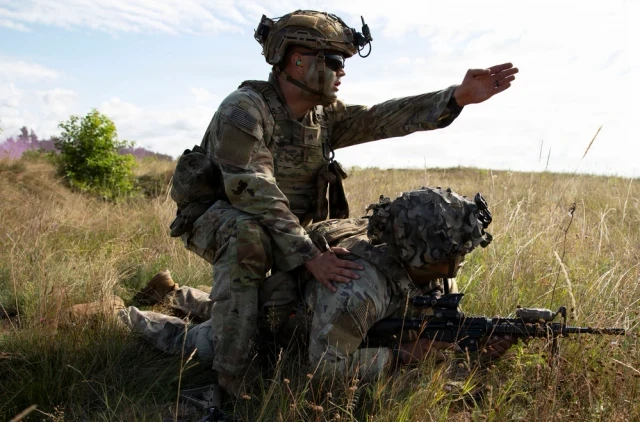
Conduct an L-Shaped Ambush, Animated Step by Step
Thirty phases, from the leader’s recon at the ORP to the choke-point withdrawal.
Read it →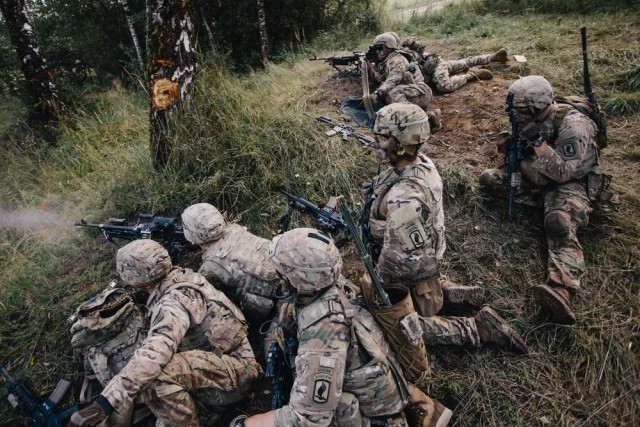 // tactics
Platoon Movement to Contact, Animated Step by Step
Forty men, 21 phases, from the LD to the red-white-blue withdrawal.
Read it →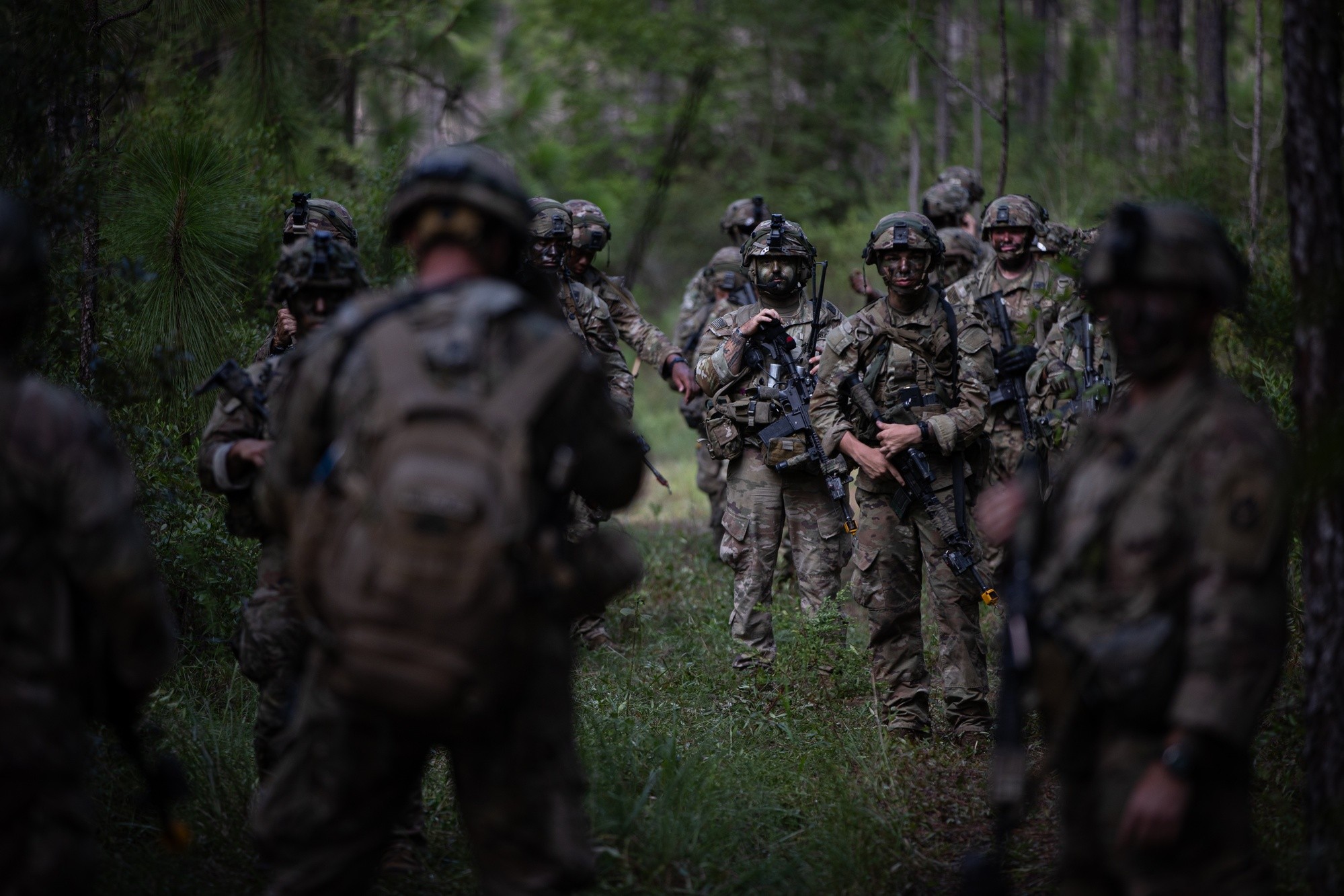 // tactics
Army Movement Formations & Techniques, Animated Soldier by Soldier
Every formation and movement technique, animated soldier by soldier.
Read it →The 4-Week Hybrid Military Program
The exact framework I use myself — built for the soldier juggling unit life, school, and a real schedule. Free PDF delivered to your inbox in under 60 seconds.
- 5 lift days · 3 run days per week, supersets for 45-minute sessions
- Week-over-week progressions targeting AFT and combat-MOS standards
- Hybrid framework — strength, conditioning, and recovery, balanced
- Built around real soldier schedules — unit time, school, family
@warfighterforged
Daily carousels. Real soldier breakdowns.