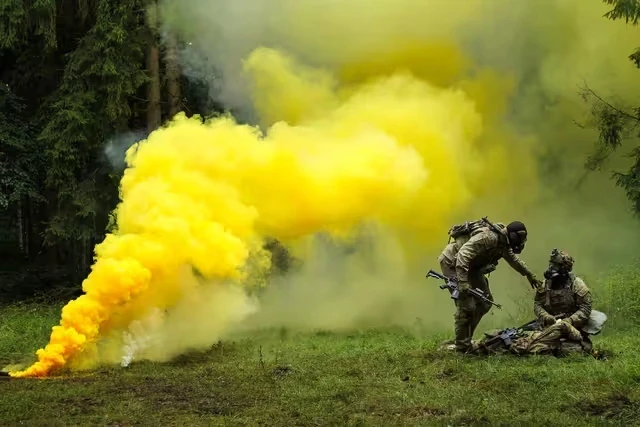
React to a Chemical Agent Attack
There is almost no warning and almost no time — the mask goes on in nine seconds, the alarm protects everyone else, and the agent decides the rest. Mask, MOPP4, decon, identify, report, move upwind. Here is the CBRN drill, step by step, the way it runs on the ground.
Interactive Walkthrough
Hit play and watch the drill unfold from above, or step through it at your own pace. Gold is A Team, blue is B Team, white is the squad leader, red is the enemy. Every movement on the map matches the written steps below.
The Ranger Handbook (TC 3-21.76) is the source for every drill on this page — mandatory kit for any military leader.
Don’t Miss the Next Drill
More patrolling and battle drill pages are being built right now, animated the same way. Subscribe and I’ll let you know the moment new tactics, articles, and gear reviews go live.
Task · Conditions · Standards
React to a chemical attack: don the protective mask within nine seconds, give the alarm and assume MOPP4, conduct decontamination and aid, identify the agent, submit a CBRN 1 report, mark the contaminated area, and move upwind to a minimum safe distance.
The element is moving or stationary, conducting operations, when it is attacked with a chemical or biological agent — soldiers hear a chemical alarm, observe an unknown gas or liquid, or are ordered to mask.
All soldiers mask within nine seconds (fifteen with a hood) and assume MOPP4 within the time standard; the element identifies the agent with M8 paper and the M256 kit; the leader reports the attack with a CBRN 1 report and moves the element upwind to a minimum safe distance.
The Full Sequence
Squads that walk this drill on a terrain model before stepping off run it clean the first time live — build the objective, talk every phase.
Comms & Reports
The Alarm
Vocal and nonvocal, the instant anyone recognizes it:
- Vocal — “GAS, GAS, GAS”
- Nonvocal — arms and fists out to the sides, bent to the shoulders, repeated (TC 3-21.60)
- Repeated so every soldier in earshot and sight masks
Masking Standard
The nine-second sequence, rehearsed cold:
- Stop breathing · don the mask
- Clear it · check the seal
- Resume breathing · 9 sec (15 with a hood)
MOPP4
Highest protective posture, assumed within the standard:
- Mask & hood · overgarment
- Gloves · jacket zipped · hood · overboots last (8 minutes from MOPP 1)
- Deliberate — gaps in the suit are gaps in your protection
Decon & Aid
Time-critical actions on exposed skin and symptoms:
- Skin decon (M291) within 1 minute
- Nerve-agent antidote — self-aid / buddy-aid
- Watch your buddy for early symptoms
Identify the Agent
What drives treatment and the stay-or-go call:
- M8 paper identifies liquid agent (M9 paper only detects it) · M4 JCAD alarms on vapor
- M256 detector kit — vapor hazard
- Read the result correctly before you act on it
CBRN 1 Report & Mark
Handing the hazard to higher and warning the rest:
- CBRN 1 to higher: lines B, D, G, I · FLASH precedence if it is the first chemical use
- Mark the contaminated area per SOP
- Request decon support · move 300 m upwind · unmask only by the procedure (M256: ~15 min; no kit: ~35 min)
SALUTE, ACE, and every report above gets written, not memorized — in the all-weather leader book that’s standard issue for a reason.
Where Squads Fail This Drill
A Slow or Broken Mask Seal
Gulping a breath with the mask half-on, or a seal broken by a beard, sweat, or fogged lenses, defeats the one thing that keeps you alive. Don, clear, seal, check — every time, in nine seconds.
Not Giving the Alarm
A soldier who masks but doesn’t pass the alarm leaves the rest of the element breathing the agent. Vocal and nonvocal both — the men who didn’t see it depend entirely on the call.
Missing the One-Minute Decon Window
Nerve agents absorb through skin fast. Skin decontamination and the antidote are one-minute actions — hesitate and the treatment is already behind the agent.
Not Identifying the Agent
Treatment, decon, and the decision to stay or move all depend on what the agent is. Skipping the M8/M256 check means treating blind and possibly wrong.
Moving Downwind or Staying Put
The agent drifts downwind, so clean air is upwind. Moving with the wind, or staying in the contamination, keeps the squad in the hazard — move at least 300 meters into the wind.
Not Marking or Reporting
An unmarked, unreported contaminated area becomes the next unit’s casualty event. Send the CBRN 1 report and mark the area before the squad moves on.