Establish an ORP: The Objective Rally Point
The Ranger Handbook gives the ORP one figure and an arrow. Here is the whole thing — leaders recon, GOTWA, the triangle, and occupation by the numbers — animated step by step by a Ranger and Sapper qualified 11B.
Interactive What an ORP Is The GOTWA Full Sequence Common Mistakes Free AFT Program Sources
// PATROLLING
Cross a Linear Danger Area
// BATTLE DRILL INDEX
BD 1&2 React to Contact BD 3 Break Contact BD 4 Ambush BD 5 Bunker BD 6 Clear a Room BD 7 Trench BD 8 Breach BD 9 IDF BD 10 Chemical
Recon and Occupation of the ORP, Phase by Phase
Nineteen phases across two locations — the security halt and the ORP site itself. The map switches screens when the element does. Tap the map for fullscreen; use the arrows to step through at your own pace.
As an Amazon Associate, WarfighterForged earns from qualifying purchases · disclosure
Don’t Miss the Next Drill
More patrolling and battle drill pages are being built right now, animated the same way. Subscribe and I’ll let you know the moment new tactics, articles, and gear reviews go live.
What an ORP Actually Is
The objective rally point is the last covered and concealed position your element occupies before actions on the objective. It sits 300 to 400 meters off the objective by day and 200 to 300 meters at night, at least one terrain feature away — and 200 is already spicy. Noise carries. Route selection, dog-legs, and light discipline are at a premium the closer you get.
By doctrine the ORP is a triangle: three legs, three apexes at the 10, the 2, and the 6, with a crew-served weapon or SAW at each apex covering the leg to its left. From here the platoon drops rucks, finalizes actions on the objective, and launches.
Picking the spot: out of sight, sound, and small-arms range of the objective; off the natural lines of drift; away from roads, trails, and inhabited areas; cover and concealment; ground you can defend for a short time; and easy to find on a dark night. The tentative ORP comes off the map in planning — it stays tentative until the leaders recon confirms it on the ground.
An ORP is an offensive position — you are minutes from the objective and speed beats comfort. No priorities of work. No sector sketches. No claymores. No R&S teams. If you are doing patrol-base tasks in an ORP, you are burning time you do not have and begging to be compromised.
The 5-Point Contingency Plan (GOTWA)
Issued by the PL to the PSG before the leaders recon steps — and again to the WSL before the PL walks back. Max 90 minutes; the clock starts when the last Ranger crosses the choke point.
Choke point at the 12 — always forward — with the PSG and medic counting all personnel out and back in · disseminate the GOTWA down to every Ranger · adjust security constantly · long-halt posture until the PL radios the far recognition signal, then short-halt: knee, ruck on, ready to move · VS-17 panel is the near recognition signal · count us back in.
The Full Sequence
- Movement: the platoon approaches in a squad column, fire team wedges — security leading, Gun 1 behind them, PL + RTO, Assault 1, Gun 2, PSG + medic + WSL, Assault 2 in trail.
- Security halt set. Assault squads on the flanks, security squad down the middle, guns at the 12 and 6.
- Assemble the leaders recon party: PL, the RTO, WSL, every AG with a tripod, a SAW gunner if you are an apex short — each one designated 10, 2, or 6 before stepping — plus all of security squad.
- GOTWA to the PSG, plus special instructions. The PSG and medic build a choke point at the 12; the party files through it one at a time and they count every Ranger out. Dog-leg the route — always forward, never back through ground you already used.
- Move the roughly 200 meters to the tentative ORP in wedges. Alpha team security leads, headquarters and the gun wedge in the middle, Bravo trails. Avoid high-speed avenues of approach; never silhouette on high ground.
- Short halt near the tentative ORP — hold the posture you moved in, take a knee, get behind cover, security out. Map check confirms the location and the day/night distance.
- Security on line facing the direction of travel. The RTO and the 6 o’clock AG turn and face the rear — they are the 6. PL and SAW far left, WSL and AG far right.
- Clear the area by bounding overwatch at the high ready out to the LOA — sized by terrain, vegetation density, and the size of the element, about 50 meters for a platoon. Read the ground for BRASS, TRASH, and ASH: any sign of enemy or civilian movement. Then SEALS: stop, look, listen, smell.
- Set the apexes. PL sets the SAW at the 10, WSL sets the 240 at the 2, and each apex gets a TRP — a big tree, a rock, something findable in the dark, so leaders can direct by it. Each gun covers the leg to its left — MSD 15° for a tripod gun, 45° for a SAW on bipod.
- Switch and check. PL walks the line 10-to-2, WSL walks it 2-to-10, each checking the other’s gun and the ground: cover and concealment, avenues of approach, fields of fire, dead space. Any reason the site will not work gets found now, with fifteen Rangers, not later with forty.
- OP out 50 to 100 meters off the 6: Bravo team leader and his automatic rifleman — early warning and the approach corridor. Bravo fills the 10-to-2 line; Alpha becomes the PL’s PSD.
- Set the 6 together. GOTWA number two goes to the WSL, who locks the triangle down with the skeleton crew. Confirm the recognition plan: far rec by radio, near rec by VS-17 panel.
- Return. Far recognition signal by radio from inside the ORP; the halt snaps to short-halt posture. Near recognition signal — VS-17 panel — at the edge of eyesight, then challenge and pass, and the PSG and medic count the party in through the choke at the 12. Fifteen went out: seven hold the triangle, two hold the OP, six come back.
- Order of movement: Alpha security → PL + RTO → Gun 1 (the 2) → Assault 1 → Gun 2 (the 6) → PSG + medic → Assault 2. Stand up squad by squad, never all at once — sudden mass movement gives the position away. The PSG and medic build the choke at the 12, count everyone out through it in a file, then fall into their place in the formation.
- Radio ahead. Far recognition signal, PL to WSL. The WSL alerts the skeleton crew and the OP — friendlies inbound, and when.
- Link up with the OP. Near recognition signal, VS-17 panel. Short halt. PSG and medic move front, take the count at the 6, become the choke point. The column picks up both OP Rangers as it passes.
- Occupy by the numbers. Everyone enters through the 6, between the PSG and medic, and files along the inside of the perimeter. Security reoccupies. PL and RTO direct traffic from the center by TRP. Gun 1 and Assault 1 fill 6-to-2 up the right; Assault 2 fills 6-to-10 up the left; Gun 2 drops at the 6 on its waiting tripod.
- Establish. Rucks on (gun teams excepted). Hasty sectors, tie in to 35 meters. SEALS again. Leader checks: apex azimuths on TRPs and identifiable ground, weapons distribution, open bolts at the apexes, honest MSDs, FPLs ready.
- Spot checks. Squad leaders walk their lines and check what the team leaders issued — sectors, limits, cover and concealment, tie-ins. Then the top three: PL on the left leg, PSG on the right, WSL at the 6 on his gun — apex guns on their PDF with FPLs set, honest MSDs, bolts open, head count matches the choke count.
- Tower of power. Leaders collapse to the center — PL, RTO, PSG, medic, WSL, and the three squad leaders — to finalize the plan for the objective. Then, and only then: ORP established.
Common Mistakes
- Straight-lining to the objective. No dog-legs means anyone who cut your trail walks it straight into your formation.
- A vague W in the GOTWA. “Radio me” is not a plan — it is the first step of a panic. Give radio windows, an azimuth, a search element with a hard LOA, and a fallback rally point.
- AGs stepping without apex assignments. The 10, the 2, and the 6 are designated before the recon moves, so every gunner knows exactly which apex to link in on.
- Forgetting the tripods. The whole point of walking AGs on the recon is that the guns drop onto set tripods and pre-designated azimuths during occupation.
- Skipping SEALS. Twice is the standard — after the recon clears the position, and again after the platoon herd-of-elephants its way in.
- Cheating the MSD. Fifteen degrees off the leg for a tripod gun is the minimum. A SAW on a bipod in the woods gets 45. Minimums are minimums — take more.
- Doing patrol-base tasks. If someone is drawing a sector sketch in your ORP, you have confused an offensive position with a campsite.
Sources & Further Listening
More Like This
 // tactics
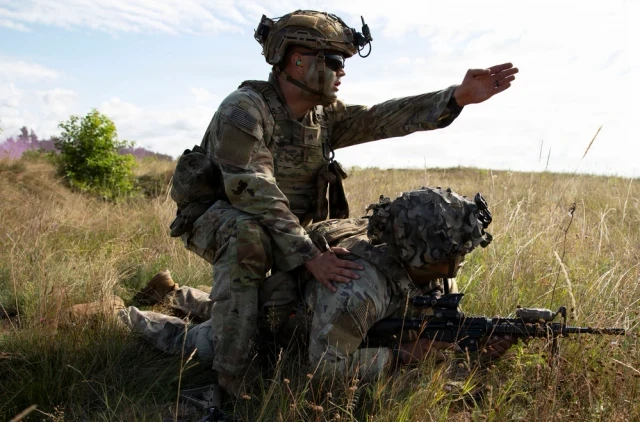
Conduct an L-Shaped Ambush, Animated Step by Step
Thirty phases, from the leader’s recon at the ORP to the choke-point withdrawal.
Read it →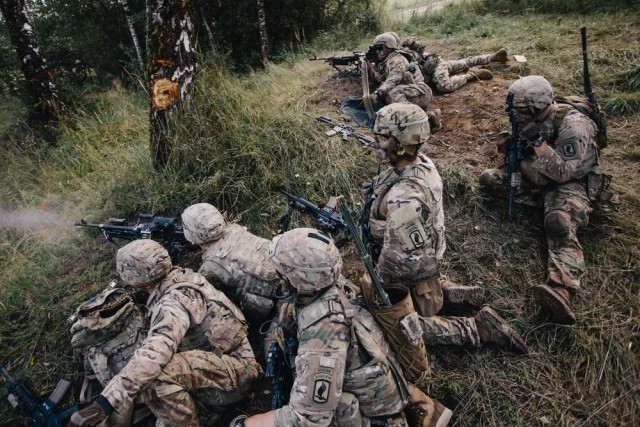 // tactics
Platoon Movement to Contact, Animated Step by Step
Forty men, 21 phases, from the LD to the red-white-blue withdrawal.
Read it →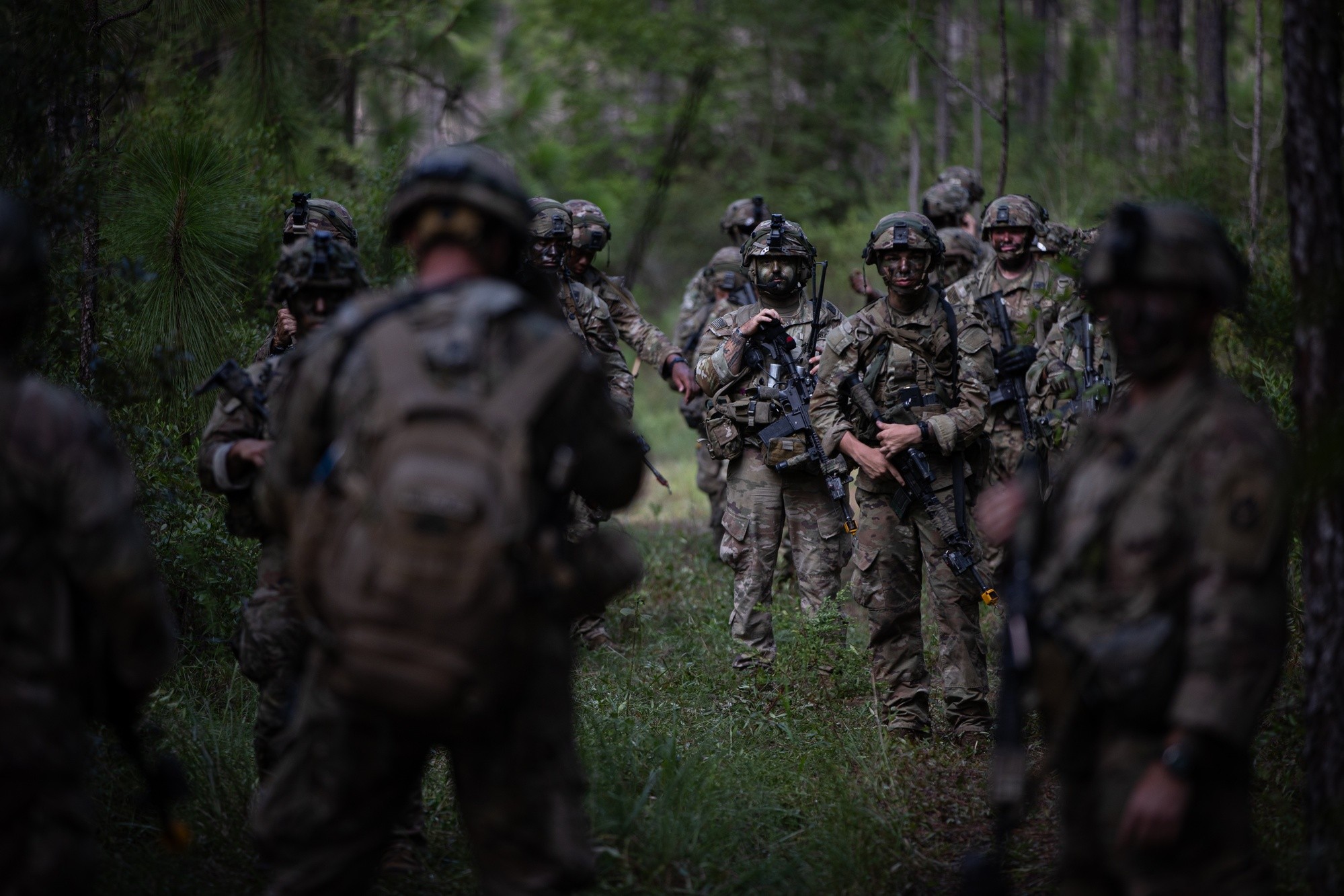 // tactics
Army Movement Formations & Techniques, Animated Soldier by Soldier
Every formation and movement technique, animated soldier by soldier.
Read it →The 4-Week Hybrid Military Program
The exact framework I use myself — built for the soldier juggling unit life, school, and a real schedule. Free PDF delivered to your inbox in under 60 seconds.
- 5 lift days · 3 run days per week, supersets for 45-minute sessions
- Week-over-week progressions targeting AFT and combat-MOS standards
- Hybrid framework — strength, conditioning, and recovery, balanced
- Built around real soldier schedules — unit time, school, family
@warfighterforged
Daily carousels. Real soldier breakdowns.