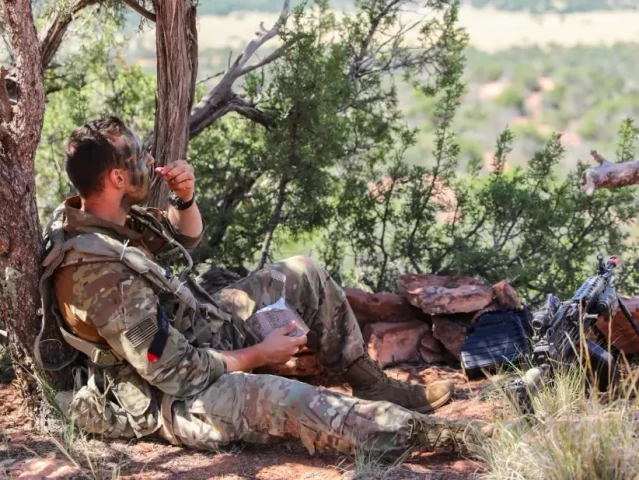
Occupy a Patrol Base, Step by Step
Everybody knows priorities of work. Almost nobody can walk you through how the platoon actually gets into the patrol base. Here is the whole occupation, from the combat football to the R&S teams, animated step by step by a Ranger and Sapper qualified 11B.
Occupying the Patrol Base, Phase by Phase
Twenty-three phases across two locations: the security halt and the patrol base site. It starts in the combat football and ends when the PL confirms the site. The map switches screens when the element does. Tap the map for fullscreen, or use the arrows to step through at your own pace.
As an Amazon Associate, WarfighterForged earns from qualifying purchases · disclosure
Don’t Miss the Next Drill
More patrolling and battle drill pages are being built right now, animated the same way. Subscribe and I’ll let you know the moment new tactics, articles, and gear reviews go live.
What a Patrol Base Is, and What It Isn’t
A patrol base is a security perimeter a squad or platoon sets when it has to stop longer than a halt allows: to hide during the day, rest and eat, clean weapons, plan and issue orders, reorganize after infiltrating, or wait for the next mission. You don’t stay longer than 24 hours unless it’s an emergency, and you never use the same site twice.
It is not a defense. You pick ground nobody wants, you stay quiet, and if you get found you break contact to the alternate patrol base. You don’t fight for the dirt.
The Ranger Handbook says a patrol base is reconned and occupied the same way as an ORP, with one planned difference: the patrol enters at a 90-degree turn and leaves a two-man OP at the turn. Everything else that’s different is what happens after. An ORP is an offensive position minutes from the objective, with no priorities of work. A patrol base is where priorities of work happen.
Picking the Spot: LEAP
The PL picks a tentative site and an alternate from the map and imagery, or higher gives him an area. The Ranger U podcast boils the doctrine down to four letters:
The rest of the doctrinal list: terrain that slows foot movement (dense vegetation, brush and trees that spread close to the ground), near a source of water such as a small brook or pond, and ground that is relatively flat and soft enough to dig. Avoid known or suspected enemy positions, built-up areas, ridges and hilltops (except a small element for comms), small valleys, and roads and trails.
The Leader’s Recon Party
Every man on the recon has a job at the site. Nobody goes along for the walk.
- PL and RTO. The radio has to be at the site, because the site has to pass a commo check before anyone else moves.
- Weapons squad leader. He stays and runs the site while the PL goes back for the platoon.
- An AG from each gun team, with tripods, not guns. They mark the 2 and the 6 so the guns drop straight onto set tripods during occupation.
- A SAW gunner for the third apex. A platoon has two 240s and three apexes, so a squad’s SAW takes the 10. Here it’s Assault 2’s automatic rifleman.
- All of security squad. They clear the site on line and become the 10–2 leg.
- The LP/OP: a SAW gunner and a rifleman with a radio, here from Assault 1. They stay at the turn.
Instructors vary the details. Some use three ammo bearers as apex placeholders, and some bring the FO. The principle doesn’t change: every apex man knows his corner before he steps off.
Three Briefs, Not One
Occupied Is Not Established
This walkthrough ends at occupied: the perimeter is set, the guns are laid in on the legs, the R&S teams are back, and the PL has confirmed the site. Established comes after priorities of work: sector sketches and range cards checked, the withdrawal plan and alternate patrol base briefed to every man, commo with higher, then maintenance, water, chow and rest. That is its own page, coming next.
From the moment the last man is on the line until the PL confirms the site, the platoon is at 100 percent, rucks on, on a knee. Not prone. If the R&S finds a problem, you are getting up and moving to the alternate.
The Full Sequence
- Movement to the Tentative Patrol Base. Squad column, fire team wedges, toward a tentative site and an alternate picked off the map.
- The Security Halt: Combat Football. Cigar-shaped perimeter 200–400 m short by day, 100–200 m at night. Assault squads on the sides, guns at the 12 and 6, HQ in the center, security squad in the middle and not tied in. Long halt, SEALS.
- Build the Leader's Recon Party. PL, RTO, WSL, the Gun 1 and Gun 2 AGs with tripods, Assault 2’s SAW gunner, all of security squad, and a SAW gunner and rifleman with a radio for the LP/OP: 17 men.
- GOTWA to the Platoon Sergeant. Five-point contingency plan to the PSG, pushed down to every man. Assault 1 and 2 re-space to cover the gap.
- Count Out Through the 12. PSG and medic choke at the 12, count all 17 out, dog-leg off the line of march, recon moves in wedges.
- Halt at the Turn: SEALS. Halt at the tentative LP/OP site. SEALS. Map check.
- Post the LP/OP, Then a Hard 90° Turn. Brief and post the two-man LP/OP, make a hard 90° right, cover tracks to the site. Gun 2’s AG marks the 6.
- Security Squad On Line at the 6. Security squad on line in front of the 6, about 50 m wide, SAW gunner on the left end and Gun 1’s AG on the right.
- Clear Through the Site. Walk the site on line 50–75 m out from the 6, reading the ground.
- Set the 10 and the 2, Walk the Shape, Commo Check. Line ends become the 10 and the 2. PL and security SL walk the triangle. Commo check to higher, the LP/OP and the PSG.
- Confirm the Site: GOTWA to the WSL. PL confirms the site, gives the WSL a GOTWA, and walks back with the RTO and Alpha team, clearing the LP/OP on recognition signals.
- Return and Count In. Counted in through the 12. PL briefs the changes.
- Order of Movement: Stand Up by Element. Stand up by element in occupation order. A three-man team wedges with one man on each side of the team leader.
- Count Out Through the 12. Count out through the 12. PSG and medic hold the choke until the last man, confirm the count, then trail.
- Past the LP/OP, Short Halt at the 6. Link up with the LP/OP, same turn, cover tracks, short halt outside the 6. WSL and PSG count every man in.
- Occupy: Security, the CP, Gun 1 and Assault 1. Alpha team back on the 10–2, PL and RTO to the CP, Gun 1 to the 2, Assault 1 fills the 2–6 leg.
- Occupy: Gun 2, Assault 2, PSG Last. Gun 2 to the 6, Assault 2 fills the 6–10 leg, medic and PSG last. Every gun gets a PDF on dead space or the likely approach and an FPL as its far-left limit: 15° off the left soldier for a 240, 45° for a 249.
- 100% Security: PL and PSG Walk the Perimeter. 100% security, rucks on, on a knee. Hasty sectors. PL and PSG walk the perimeter clockwise from the 6.
- R&S Teams to the CP. One two-man R&S team per squad to the PL at the CP, the tower of power. The PL sets the SLLS time. The line is told friendlies are out.
- R&S: Security Squad Out, the 10–2 Goes Cold. Security squad’s team goes first: out the left flank, SLLS at both far corners, in the right flank, report to the PL, back on line. The 10–2 side, apexes included, goes muzzles down while it’s out.
- R&S: Assault 1 Out, the 2–6 Goes Cold. Assault 1’s team, same way. The 2–6 side goes muzzles down.
- R&S: Assault 2 Out, the 6–10 Goes Cold. Assault 2’s team, same way. The 6–10 side goes muzzles down.
- Confirm or Deny: Patrol Base Occupied. PL confirms or denies. On confirm: claymores out with the wire back to the line, AT4 firing positions set. Occupied. Priorities of work come next.
Where the Sources Split
The Ranger Handbook gives patrol base occupation six short steps and one figure. Everything else is unit TTP, so you will hear it taught different ways. Here is where the good sources disagree, and what this walkthrough shows.
- When the LP/OP gets dropped. The Handbook leaves a two-man OP at the turn on the way in, and that’s what’s shown here. Danger Ranger drops the pair on the PL’s way back, briefing them in person. Dropping them on the way in covers the back trail the whole time the recon is at the site.
- How the site gets cleared. The Handbook says recon it like an ORP. Ranger School practice is security squad on line with an apex man on each end, as shown. University of Iowa Army ROTC teaches a cloverleaf from the 6 (to the 12, the 9, the 3 and back), dropping men at the 10 and 2, and calls the on-line method the better choice at night.
- How the platoon moves in. The Handbook: the PL brings the platoon forward and the trail squads occupy the 2 to 6 and the 6 to 10. Iowa ROTC’s TTP sends one squad at a time from the LP/OP, with the WSL meeting each at the 6. Shown here: the platoon in file, counted through a choke at the 6.
- R&S methods. The Handbook lists the I, the T and the box, out the left flank and in the right. Danger Ranger adds the post (straight out and back, the fastest) and the apex or cloverleaf (the most thorough), and sends one team out at a time.
- Gun angles. The Handbook figure puts guns at the 2, 6 and 10 covering the front of the squad to their left. In practice each gun gets a PDF (primary direction of fire) on dead space or the most likely approach and an FPL (final protective line) as its far-left limit, 15 degrees off the left soldier for a tripod 240 and 45 degrees for a 249, so the gun can be swung to the FPL in the dark or when overrun without ever crossing friendlies.
Common Mistakes
- Occupying off the map. The site is tentative until the recon walks it. You never occupy a patrol base by force.
- Skipping the turn, or skipping SEALS at it. The turn exists to catch whoever is following you. Walk straight in and you lead them to the platoon.
- No commo check from the site. If the site can’t reach higher, the LP/OP and the PSG, keep looking.
- Tying security squad into the halt, then ripping them back out for the recon. Park them in the middle.
- A vague GOTWA. “Radio me” isn’t a plan. Give radio windows, a search element with a hard limit, and the alternate patrol base.
- Going prone during R&S. 100 percent, rucks on, on a knee. You may have to move right now.
- R&S leaving without the line knowing. Every squad leader tells his line that friendlies are out front.
- Calling it established when it’s only occupied. No withdrawal plan and no sector sketches, and half the platoon is already asleep.
- Reusing a site or staying past 24 hours. Someone saw you come in. Assume it.
Sources & Further Watching
More Like This
 // tactics
Conduct an L-Shaped Ambush, Animated Step by Step
Thirty phases, from the leader’s recon at the ORP to the choke-point withdrawal.
Read it → // tactics
Platoon Movement to Contact, Animated Step by Step
Forty men, 21 phases, from the LD to the red-white-blue withdrawal.
Read it → // tactics
Army Movement Formations & Techniques, Animated Soldier by Soldier
Every formation and movement technique, animated soldier by soldier.
Read it →The 4-Week Hybrid Military Program
The exact framework I use myself — built for the soldier juggling unit life, school, and a real schedule. Free PDF delivered to your inbox in under 60 seconds.
- 5 lift days · 3 run days per week, supersets for 45-minute sessions
- Week-over-week progressions targeting AFT and combat-MOS standards
- Hybrid framework — strength, conditioning, and recovery, balanced
- Built around real soldier schedules — unit time, school, family
@warfighterforged
Daily carousels. Real soldier breakdowns.